
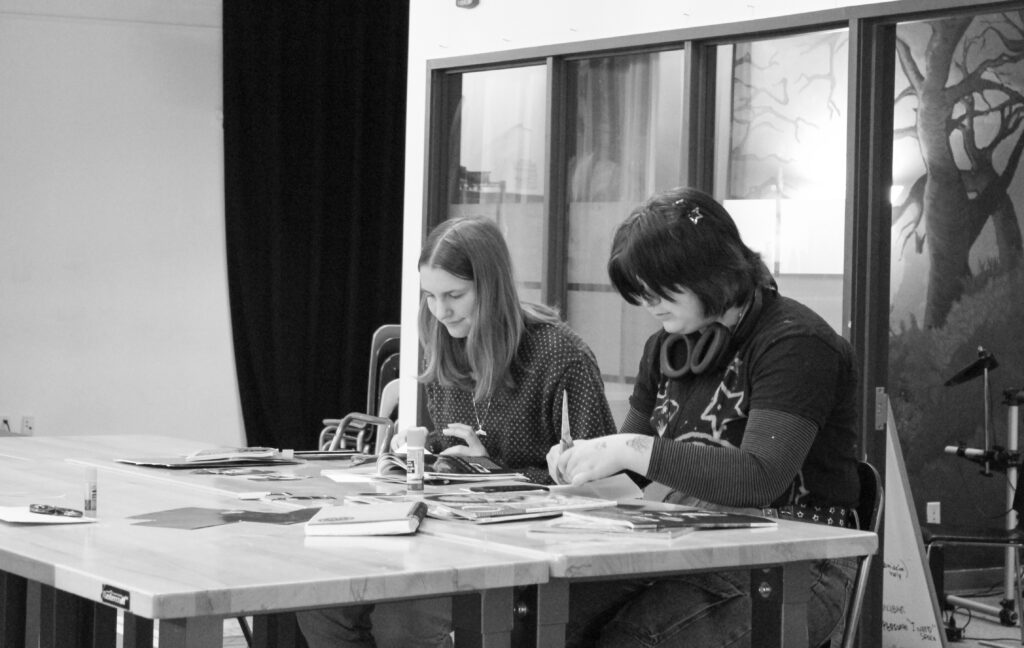
Photo by Brianna Mellings
At PSII, teachers are professional facilitators of learning, who adapt learning conditions to be developmentally appropriate to each learner, who encourage and seamlessly incorporate legitimate in and out-of-school learning experiences, and who offer or connect learners with expertise as demanded by co-created individual learning.
Why do you use the term “learner”?
Student (from the verb “to study”) suggests that a person looks to knowledge that already exists in order to understand the world and to develop their worldview. Learner (from the very “to learn”) suggests that a person doesn’t just familiarize themselves with existing knowledge, but that they are actively making connections between ideas, their experiences and observations. Learning is a necessarily creative process through which what is being learned is also being applied, looked at from different perspectives, and put into context.
Can I go to college or university afterwards?
Yes! You can go to college, university, or into any other career path after PSII! Transcripts for PSII learners look just like transcripts from other schools that offer graduation in BC. Because of the self-awareness, time-management, critical thinking, and self-advocacy skills developed by PSII learners, we see our graduates step into post secondary environments well-equipped to handle challenges.
Can I graduate with a BC Dogwood Diploma?
All PSII graduates receive a BC Dogwood certificate.
PSII vs Most High Schools
PSII
Most High Schools
Subjects, courses and classes
Subjects are integrated; the BC curriculum + is uncovered in interdisciplinary combinations
Subjects are segregated into separate courses/classes where BC curriculum is covered
Level of personalization
Personal learning paths are co-created by learners and teachers. Intersection points and emerging needs/goals inform what is done individually and what is done in groups.
Courses are pre-designed for a batch of 20 to 30 students with some post-design differentiation after the fact, based on student need/interest in some cases.
Curriculum design
Curriculum is built on personal curiosity through a close learner-teacher relationship, with room for occasional “nudges” by the teacher into areas of learning the learner may not have thought of alone. Learning is based on valued human attributes, then competencies, then personal and universal learning goals.
Curriculum is built on “behavioural outcomes” where every student is asked to demonstrate the same learning behaviour. Some competencies are also referenced, but are lower on the hierarchy than the outcomes.
How learners are grouped
Learners are grouped when it makes sense in whatever configuration makes sense. Sometimes by interest, sometimes by similarity, sometimes by difference. Groupings are dynamic.
Students are typically grouped by age/grade level. Classes are organized ahead of time and groupings do not change for a semester of a whole year.
Learning environment
Learners are the main units of learning, and so the school has micro-environments of many different shapes and sizes. Some areas are specialized, but almost everything is flexible.
“Classrooms” are the main units of learning, so school buildings are organized into rooms of 20 to 30 to hold the average batch size. Some rooms are specialized but many are generic.
Connection to the greater community
Learners are encouraged to develop real projects, based on their own inquiries, and to access the world outside for mentorship, modelling, ideas for future projects, and as a place for them to contribute to society.
Schools try to offer hypothetical models within the school walls to allow students to demonstrate learning and skill development. Community-based projects are the exception.
Face-to-face or virtual
PSII learners will be in a hybrid environment by necessity. There is no substitute for face-to-face (at least 90% of what students will experience each day) when human relationships are valued, but because learners could be learning almost anything at any time, virtual experts will often comprise part of the resources learners will access.
Most high schools are either face-to-face or are based in a “distributed learning” model where students access learning via technology. Almost all face-to-face is with a teacher alone, and almost all virtual access looks a lot like correspondence courses, only on a computer screen.
Physical health
Learners will learn about a holistically healthy lifestyle, including physical health, and will co-create a physical health plan (and assess progress) with a teacher, but will experience it at the Victoria YMCA, Crag-X, and/or other locations that best fit the personal learning goals.
Physical education is taught in a gym, with team sports as the main method of providing physical activity. Everyone in a PE class usually does the same thing at the same time, regardless of experience, preference, body type, or health status.