
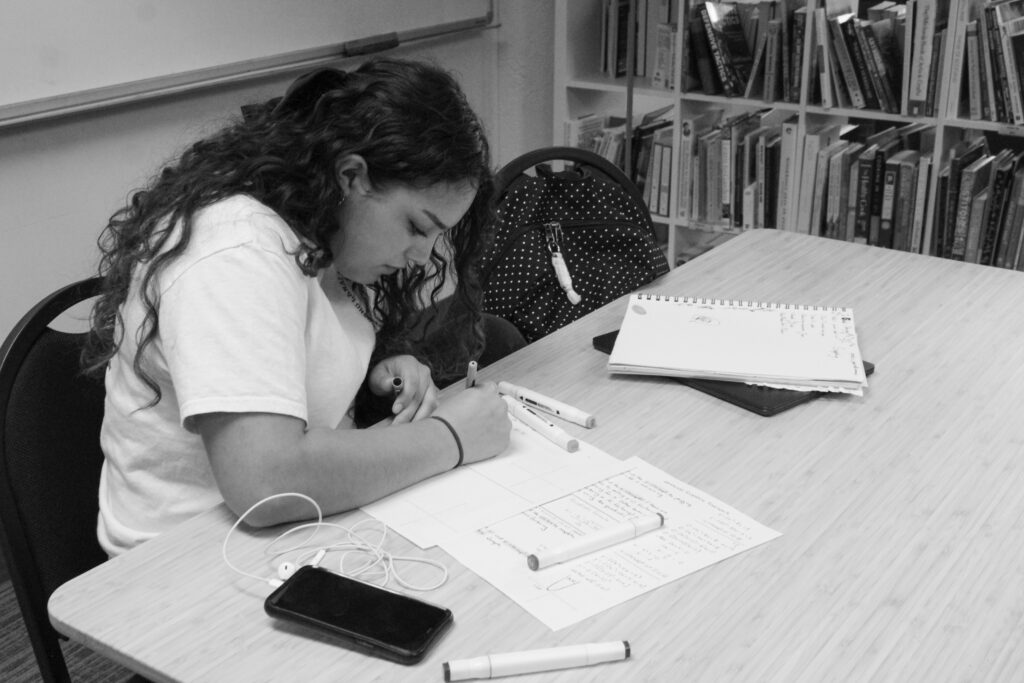
Photo by Brianna Mellings
Assessment is an essential part of the inquiry process.
Baseline Assessment
Of & For Learning
- before you learn something
- at any stage of inquiry
- Identify your current knowledge
- topic specific
- skill specific
Formative Assessment
For & As Learning
- while you are learning something
- at any stage of inquiry
- Self Assessment → pause & reflect
- Feedback on your learning (including process)
- topic specific
- skill specific
- Where I am right now → what are my next steps?
- topic specific – increasing depth
- skill specific – increasing depth
Summative Assessment
Of Learning
- after you have learned something
- at an end point or transition to the next stage
- I’ve completed a stage of learning
- topic and skills
Each of these reasons ultimately help you to reflect on where you have been and where you are now to support you in determining where and how to move forward.
PSII Competencies

Ecological Literacy
The understanding of closed systems, including the relationships of elements or organisms with one another and with their context or physical surroundings.
Indicators
- Evidence of systems thinking
- Recognizes the universe as an integrated whole rather than a collection of individual elements
- Aware of a system’s capacity and the factors that influence it
- Understands the interconnectedness of systems
- Considers the impact that a behaviour or a decision can have/did have on a system
- Creates a system in order to meet a need and/or solve a problem

Reading, Writing, Listening & Speaking
The application of skills and techniques involved in effective communication in today’s world.
Reading Indicators
- Reads from a variety of sources
- Constructs meaning from text
- Analyzes key elements & features of text
- Responds in a variety of forms
- Identifies as applicable: theme, bias, main idea, purpose, tone, voice, characterization, narration, suspense, literary devices
- Selects text that supports learning goals, including context/objective goals
- Demonstrates inferential comprehension
- Demonstrates literal comprehension
- Demonstrates pre-, during-, and post-reading strategies
Writing Indicators
- Employs writing format appropriate to the learning goal and/or purpose of the writing
- Uses pre-writing strategies to organize and to plan
- Chooses language that is purposive, including word choice, style, voice, tone, sentence structure, etc.
- Communicates main idea(s), either explicitly or implicitly, depending on goal
- Uses literary devices in writing as appropriate to the goal(s) of the writing
- Employs editing and revision strategies
- Uses writing to synthesize/summarize ideas from other sources
- Uses grammar and other writing conventions as appropriate to context
- Demonstrates awareness of social and cultural conventions and the impact of word choice on others
Listening Indicators
- Employs active listening skills, encouraging/supporting others to speak/share ideas
- Seeks understanding; asks clarifying questions
- Takes into account own bias and how it may affect meaning and/or empathy
- Demonstrates an awareness of how context, body language, and nonverbal communication inform meaning
- Employs recording strategies to retain ideas that are received through listening.
- Listens with attention and to the point necessary to uncover main idea/theme
Speaking Indicators
- Uses strategies to organize and to plan before speaking, when appropriate.
- Chooses language that is purposive, including word choice, style, voice, tone, sentence structure, etc.
- Communicates main idea(s), either explicitly or implicitly, depending on goal
- Chooses structure, content, language, and tone of language with intention and to match setting, goal, and audience
- Awareness of social and cultural conventions and the impact of word choice
- Responds to others in a way that enhances or builds conversation
- Employs speaking techniques appropriate to context, subject, purpose, audience
- Employs self-correction/honing /editing of speech to acquire greater accuracy

Mathematical Literacy
A working knowledge of the language of math, including what numbers and other symbols mean, how space (both real and imaginary) can be explored and described through math, and choosing mathematical strategies to solve problems effectively.
Indicators
- Asks questions of a mathematical nature
- Uses various strategies to approach a problem or situation
- Recognizes and uses patterns and relationships
- Makes sense of, relates, uses, and/or creates mathematical representations
- Uses symbolic, formal, and technical language
- Uses an understanding of context to guide the mathematical process
- Uses tools that may assist in implementing processes and procedures for determining mathematical solutions
- Understands the extents and limits of a mathematical solution

Collaboration & Leadership
The application of skills, attitudes, and techniques involved in interpersonal relationships, especially in the employ of creativity, analysis, understanding, evaluation, and problem- and solution-finding.
Indicators
- Articulates a clear vision of the intent of the collaboration
- Works to develop, agree upon, and achieve shared goals
- Demonstrates flexibility and adaptability
- Observes behaviour and reflects/responds
- Recognizes possible roles within a group and shares responsibilities
- Creates opportunities for others to contribute and to learn
- Contributes something of oneself to a group effort
- Supports and encourages input from the group and provides constructive feedback
- Demonstrates habits and behaviours that are a positive model for others
- Demonstrates recognition of individuality/personality when working with others
Critical & Creative Thinking
The awareness and application of different techniques, thought-framing models, and approaches to a variety of challenges, problems, and opportunities.
Indicators
- Connects ideas in novel ways, or connects previously dissociated ideas
- Extracts information from explicit and implied sources
- Develops and/or applies structures/strategies/processes/methods to make a decision
- Applies logic to draw a conclusion
- Practices metacognition
- Applies prior knowledge to identify, understand, and solve new problems
- Identifies or constructs solution(s)
- Evaluates methods/ solutions
- Generates questions to compose line of inquiry
- Connects procedures with outcome
- Employs imagination/ intuition/ insight/play
- Identifies and/or creates pattern(s)
Cultural Awareness & Understanding
The development of intercultural competency, including the understanding of the dynamic nature of culture, one’s own culture, the relationship of culture to the physical world, and the role of culture on the development of world view.
Indicators
- Explores culture with curiosity and sensitivity
- Recognizes culture and how it affects attitudes, beliefs, and experiences
- Acknowledges intra-cultural and inter-cultural diversity
- Enhances knowledge of own cultural origins and/or those of a culture of interest
- Recognizes cultural differences in all aspects of life (art, language, food, economics, tech….)
- Cultivates empathy in such a way as to understand that there are diverse ways to be in the world
- Demonstrates understanding of low/ vs. high-context cultures and situations
- Explores diverse ways of knowing and being
- Explores how morals and values are inherent in cultural framework

Media & Information Literacy
The application of how to share information, how to recognize and analyze bias and purpose, and how to use multiple forms of media to express ideas.
Indicators
- Understands the role and functions of media and other information providers in democratic and non-democratic societies
- Recognizes and articulates need for information
- Locates and accesses relevant information
- Evaluates critically information and media content in terms of authority, credibility, and purpose
- Extracts and organizes information and media content
- Synthesizes or applies the ideas abstracted from content
- Communicates ethically and responsibly an understanding of created knowledge to an audience, in an appropriate form and medium
- Applies ICT skills to process information and to produce own content
- Engages with media for self-expression,dialogue, and democratic participation

Personal Planning & Responsibility
Understanding the balance between rights, freedoms, opportunities, and responsibilities. Developing skills, habits of mind, and knowledge that will allow a person to feel competent in the pursuit of their life goals.
Indicators
- Sets goals that support the whole person (mind, body, heart, spirit, joy)
- Segments goals, as appropriate, into steps or tasks
- Sets priorities based on importance, urgency,availability of resources, sequence, timing, …
- Communicates with others about goals, seeking help or accessing help independently where appropriate
- reflects on process, including the evaluation and adjustment of a plan as needed, and when making future plans
- considers the long- and short-term in the planning process
- Balances responsibility to self and others
- Differentiates between personal responsibility and group responsibility or the responsibility of another person
Flip through the pages of the PDF document below to see how we assess PSII’s key competencies, and also how those competencies fit with high level objectives and contexts.